The cut with fewer panels

- Raw panel area0,17
- 10% area allowance0,02
- Panel allowance0,25
Estimated Fabric Usage0,43
Dressmaker Guide
Learn what actually determines how much fabric a dress needs, why panel size and panel count both matter, and how to compare patterns before you buy or cut.
Fabric Usage
Larger panels use more fabric, but panel count matters too. Two patterns with the same total panel area can still have different estimated fabric usage.
Measured against build 25482629: 178 patterns share 236 construction variants, which cut 1871 panels between them.
01 — The formula
Dressmaker starts with the combined area of every panel, adds a 10% allowance to that area, then adds a small extra allowance for each individual panel.
Estimated Fabric Usage = 1,10 × total panel area + 0,05 × panel count
Applied to every cut in build 25482629, that arithmetic reproduces all 236 published estimates exactly.
Nothing else is in it. There is no term for fabric type, colour, price or how the panels are arranged.
02 — Panel count
These are two different patterns, and their panels cover the same total area — so the cloth-covered part of the estimate is identical. One of them is simply cut into more pieces, and the estimate is charged for every piece.
Same total panel area
The cut with fewer panels
The cut with more panels

Same total area does not always mean the same Fabric Usage.
The area term is identical on both cards. The whole difference — 0,55 m — is the per-panel allowance for 11 more panels.
The panel allowance is not a rounding detail: on a cut with many pieces it is a visible share of the estimate, and it is the one term you can change without changing the shape of the garment.
03 — Where the number comes from
Pick a pattern and the cut you mean. Everything below is the game's own arithmetic applied to that cut: what the panels cover, the allowance added to that area, and the per-panel allowance that turns the total into the estimate.
12 panels · No bias-cut panel
Estimated Fabric Usage
3,59
So the estimate is not one number with a mysterious origin: 24% of it is allowance rather than cloth-covered area, and the two allowances are printed separately above.
04 — What moves it
Fabric Usage is not a property of a pattern's name or its silhouette. It is measured on a cut, and only three things move it.
The base of the estimate: more cloth-covered area means more fabric, in a straight line. This is the factor players already expect.
The second term, and the one that surprises people. Two cuts with the same total area are not equal once one of them is split into twice as many pieces.
A pattern's cuts do not share an estimate. Panel count and panel area both change between variants, so the figure has to be read per cut.
This build is large enough for that to matter: 176 of 178 patterns cut cloth, 236 variants ship in total, and 51 patterns offer more than one cut to choose between.
05 — Pattern and variant
The estimate belongs to the variant you actually cut, not to the pattern you picked in the sketchbook. Take Mother of Pearl Skirt: its dearest cut needs 1,57 m more cloth than its cheapest, and nothing about the two garments on the mannequin explains the gap on its own.
| Variant | Panels | Panel area | Estimated usage |
|---|---|---|---|
| Variant 1 | 12 | 2,71 | 3,59 |
| Variant 0 | 12 | 4,14 | 5,15+1,57 m more |
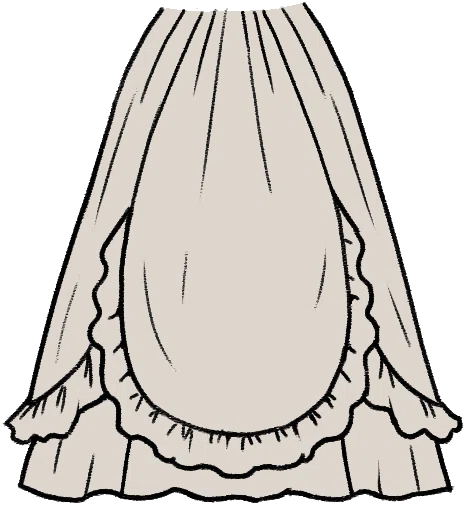
Skirt
Do not assume every variant of the same pattern costs the same amount of fabric.
Both ends of this ladder cut 12 panels, so what changed is the area those panels cover — not how many pieces there are.
06 — Bias cut
No. The recovered formula has two variables — panel area and panel count — and bias is not one of them. There is no bias multiplier of 1.25× or anything else hiding in it.
The game does record which panels are cut on the bias, which is why the counts are printed on the variant chips and in the pattern tables. That is a construction flag, not a surcharge: nothing in the arithmetic that produces the estimate reads it.
The cut with the most bias panels in this build is Koi Skirt, Variant 1, where 12 of its 12 panels are cut on the bias. Its estimate is 1,85 m — produced by the same two terms as a cut with no bias panels at all.
The most bias-heavy cut in this build
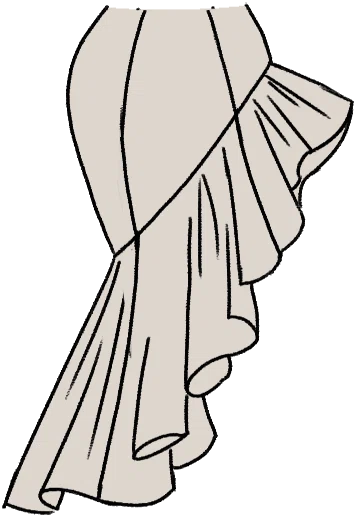
28 variants across 23 patterns in this build carry bias-cut panels — 77 panels in total — and every one of them is estimated with the same two terms as everything else.
Panel area, panel count, and the two allowances. This is the number the draft asks you for.
How conveniently the panels actually sit on the cloth once you start cutting. Bias orientation is real here, and so is the extra room a diagonal piece can need.
The estimate is based on panel area and panel count. Bias can affect how you arrange panels while cutting, but the extracted formula adds no fixed bias surcharge.
"Bias cut always uses 25% more fabric" and "bias automatically doubles usage" are both stronger claims than the data supports, and a guide that repeated them would be quoting a rule the game does not apply.
Keeping those two apart is the point. A layout that is awkward is not the same as an estimate that is higher.
07 — Grain
It is tempting: rotate a panel and it drops into the gap you have left, and the layout suddenly looks tidy. Nothing in the cloth estimate rewards that, and something else charges for it.
Usage estimate 3,59 m — the cut the game expects, with its grain lines followed.
The same cut, laid out tighter. The estimate does not move; the grain reading the game scores does.
Using less space is not the same as using the right direction.
Fabric Usage is measured on the cut, not on how neatly you managed to lay it out. Grain is one of the readings Quality is scored from, so a tighter layout bought with an off-grain panel is paid for somewhere else entirely.
08 — Before you buy
Start from the game's own estimate for the pattern and the variant you are actually making. Do not estimate from the finished silhouette, and do not carry one pattern's number over to another: two cuts that look alike can sit more than a metre apart.
The cloth you hold is above the estimate, with 0,41 m left over. This is the state to be in before the first cut.
The cloth you hold is below the estimate, short by 0,59 m. Cutting begins and cannot finish, which is the situation the recovery pages are written for.
The two supplies above are half-metre steps either side of the same estimate, so the pair shows where the boundary is rather than recommending a shopping list for one pattern.
09 — Usage is not composition
These two get read as the same requirement, and they are not even measured in the same units. One is a quantity of material; the other is a share of the garment.
One figure for the whole cut, in the game's own cloth units. It says nothing about which fabric type those panels are covered with.
3,59
A share of the garment's panel area — the area, not the number of pieces and not the metres you bought. That is why a commission can be failed for composition while the fabric amount is perfectly correct.
Dress panel area
A rule written Silk ≥ 50% means half of the dress's panel area has to be Silk panels. It does not mean half of your cloth is Silk, and it is not half of the Fabric Usage estimate being Silk either.
A cut that needs 3,59 m of cloth could have 60% of its panel area in Silk and 40% in Cotton. The requirement is met by the shares of the dress, while the amount of cloth is unchanged at 3,59 m.
A fabric amount problem is a Fabric Usage problem. A commission percentage problem is a Fabric Composition problem.
10 — Usage is not cost
Usage says how much material the dress needs. Cost says how much that material costs. They are different questions, and the lighter dress is not automatically the cheaper one.
A quantity, produced by the two terms above, and identical whatever you paid for the cloth.
That quantity priced in the fabric you actually chose, which is why the same cut can be a bargain or a disaster depending on the shelf it came from.
The lighter cut, in the dearest cloth
Variant 1 · Alexandria Printed Velvet
The heavier cut, in the cheapest cloth
Variant 0 · Amethyst Cotton
The heavier cut is the cheaper dress here: 210 less, for 1,57 m more cloth.
Both figures are fabric-only costs, and both were produced with the cost arithmetic below rather than by multiplying an estimate by a price.
The usage estimate adds 0,05 for every panel. The bill is charged on 0,02 for every panel, with the same area allowance. Two formulae, two constants, one digit apart.
There is no arithmetic shortcut between the two figures. Taking the estimate and multiplying it by a fabric price, or dividing a cost by a price to recover an estimate, produces a number the game never prints — so the site's calculators price a cut separately instead of reusing one result for both.
Decorations are not in either figure: a trim is priced per placement rather than cut from the cloth, so a fabric cost here is a cloth cost only.
11 — Using less
There is no trick that lowers the estimate. What you can do is choose a cut that genuinely needs less cloth, and avoid the mistakes that consume cloth you already paid for.
Fabric Usage is a cost of the dress you were asked to make. It is a number to plan around, not a number to defeat.
12 — When the estimate was right
The estimate is about a cut, and a dress goes wrong after the cut. If the cloth ran out while the figure was right, one of these four is usually why.
This page explains the number, and the number is not the problem here. A shortage has its own four questions and they are about what to do next, so the recovery steps live on their own page.
13 — The order to do it in
Every item below is cheaper before the purchase than after it. Work down the list, then go and cut.
The last step is the one that matters. Buying and cutting are the two irreversible moves, and every earlier item on this list is a decision made on screen.
14 — Questions
Total panel area × 1,10, plus the panel count × 0,05. The area term covers the cloth the panels cover with a 10% allowance on top, and the second term adds a small allowance for every individual panel.
Because they are not similar in the two things the estimate reads. Their panel areas can differ, their panel counts can differ, or both can — and a cut split into more pieces is charged more allowance for the same covered area.
Yes. Every panel adds 0,05 to the estimate, so a cut with twice as many pieces covering the same area is the more expensive of the two.
Not in the estimate. There is no fixed bias multiplier in the extracted formula — only panel area and panel count are read. Bias orientation can still make a layout awkward to arrange on the cloth while cutting.
No. Grain and usage are separate mechanics: the estimate is measured on the cut, while grain is one of the readings Quality is scored from. Do not misalign grain to make panels look more tightly packed.
That is a Fabric Composition requirement, not a Fabric Usage one. It asks for half of the dress's panel area to be covered by that fabric type, which is a different measurement from how much cloth the garment needs.
No. Usage measures material; cost prices that material in the fabric you chose and is produced by its own arithmetic, with a different per-panel term. A lighter cut is not automatically the cheaper dress.
Then it is no longer a question about how the estimate works. The shortage has its own page, with the order to check the situation in and the ways out of it.
16 — Scope
This is the mechanics page for Fabric Usage: what the estimate is made of, which of those parts you can change, and which of them the game does not charge for at all. It is written to be read before a purchase, which is the only moment the number is still free to act on.
It is not the calculator, and it deliberately does not print a table of every pattern: the number belongs to a cut, and a table of 178 patterns would answer a question nobody asked. It is not the buying guide either, and it does not cover shortages — it explains the figure, and points at the pages that act on it.
The formula is read out of the same recovered arithmetic this site's calculators price with, not out of a description of it, so the coefficients printed here and the figures the tools produce cannot drift apart.
Figures measured against data build 410, which lists no published change to the fabric usage formula.
This is one of the gameplay guides that together make up the Dressmaker guide.